
Why Regular STI Testing Matters
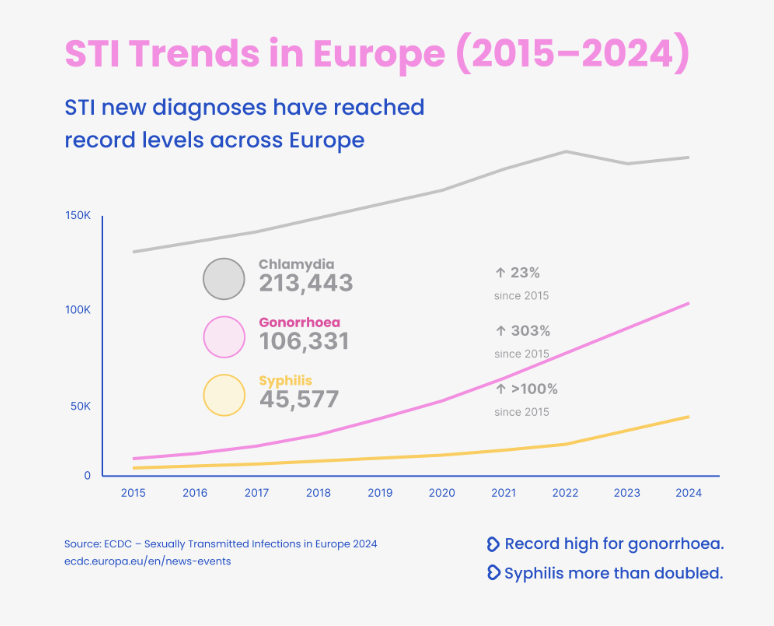
Sexually transmitted infections (STIs) remain an important public-health problem in Europe. In 2024, EU/EEA countries reported 213,443 cases of chlamydia, 106,331 cases of gonorrhoea and 45,577 cases of syphilis. Gonorrhoea notifications were 303% higher than in 2015, while syphilis notifications more than doubled. These figures reflect reported diagnoses rather than the true number of infections, because surveillance is affected by differences in testing and reporting between countries. Nevertheless, they indicate substantial and continuing transmission across Europe.
Testing is an important part of the response because many STIs can be present without symptoms. WHO’s 2025 guidelines specifically identify asymptomatic infection as a major challenge, including infections that occur at sites that may not be routinely tested, such as the pharynx and rectum. A person who feels well may therefore still have an infection and may transmit it without knowing that they are infected.
This is particularly relevant for chlamydia and gonorrhoea. Both infections can be asymptomatic, and the absence of symptoms cannot reliably be used to determine whether testing is necessary. Screening therefore has a role beyond investigating symptoms: it can identify infections that would otherwise remain undiagnosed.
The limitations of symptom-based testing
Traditional healthcare pathways often rely on people seeking care when they develop symptoms or become concerned about a possible exposure. This approach is necessary for symptomatic infections, but it does not address infections that produce few or no symptoms.
The consequences of undiagnosed infection can extend beyond transmission. Depending on the infection, untreated STIs can cause complications affecting reproductive health, pregnancy and other organ systems. Early diagnosis also provides an opportunity for appropriate treatment and, where indicated, partner management.
For this reason, STI testing should not be understood exclusively as a response to illness. For people with ongoing exposure to STIs, testing can also form part of preventive healthcare.
This does not mean that every sexually active person requires regular screening for every STI. Current WHO guidance emphasises that screening should be based on factors including sexual exposure, partner exchange, local transmission and the resources and costs associated with testing. Screening recommendations therefore differ between populations and settings.
Testing frequency should reflect exposure
There is no scientifically justified universal interval at which everybody should undergo an identical STI panel. Testing may be appropriate after a specific exposure, following a partner’s diagnosis, when symptoms occur, or periodically for people with continuing exposure. National and clinical recommendations also differ according to population and epidemiological context.
For example, WHO recommends at least annual or six-monthly screening for some populations with increased exposure, while ECDC reports that regular 3–6-month screening is common for all three major bacterial STIs among HIV PrEP users in approximately two-thirds of reporting European countries.
A four-month interval therefore should not be presented as a universal medical recommendation. It is better understood as a practical recurring interval for people who require or choose regular STI screening, with the actual tests and frequency determined according to their circumstances and appropriate clinical guidance.
Access is part of the testing problem
The effectiveness of screening depends partly on whether people actually use the available services. Testing can involve appointments, travel, waiting times, costs, concerns about privacy and the practical difficulty of fitting healthcare into everyday life. These barriers can be particularly relevant for people who move frequently, live in different countries, have irregular schedules or prefer not to attend a clinic for every screening episode.
ECDC’s assessment of STI responses across Europe has identified persistent gaps in access to testing and prevention. European testing systems also differ considerably between countries, including in the availability and financing of different testing approaches.
Improving access therefore does not necessarily require creating a completely different diagnostic system. It can also involve making established testing methods easier to use.
Evidence for home self-collection
There is increasing evidence that self-collection outside a healthcare facility can improve access to STI testing.
A 2024 systematic review and meta-analysis evaluated 19 studies involving 62,369 participants, including 15 randomised controlled trials. For chlamydia and gonorrhoea, offering specimen self-collection at home or in another non-clinical setting resulted in 2.61 times greater testing uptake than collection in clinical settings. The studies also found high agreement between samples collected at home and in clinical settings, while linkage to treatment was not significantly different between the two approaches.
A separate 2024 systematic review examining self-collected specimens for several STIs found that, for most infections studied, diagnostic accuracy was comparable with specimens collected by healthcare workers.
The evidence does not suggest that home testing should replace clinical care. Rather, it supports self-collection as an additional testing pathway, particularly where it increases participation among people who might otherwise not test.
The test must correspond to the exposure
An important limitation of simplified STI testing is that there is no single sample that detects every infection in every circumstance.
The appropriate test depends on the infection being investigated and, for some infections, on the anatomical site exposed. WHO specifically notes that testing for chlamydia and gonorrhoea may need to consider genital, rectal and pharyngeal sites according to sexual behaviour.
A responsible testing service should make clear:
- which infections are being tested;
- which type of sample is required;
- which anatomical sites are covered;
- the limitations of the test;
- when laboratory or clinical testing is preferable;
- and what to do following a positive or inconclusive result.
This is particularly important when a subscription model is used, because regular testing should not become a reason for people to repeatedly perform an inappropriate or incomplete test.
Why a subscription?
The rationale for ENDO’s subscription is for people who require regular testing and should not have to reconstruct the testing process every time.
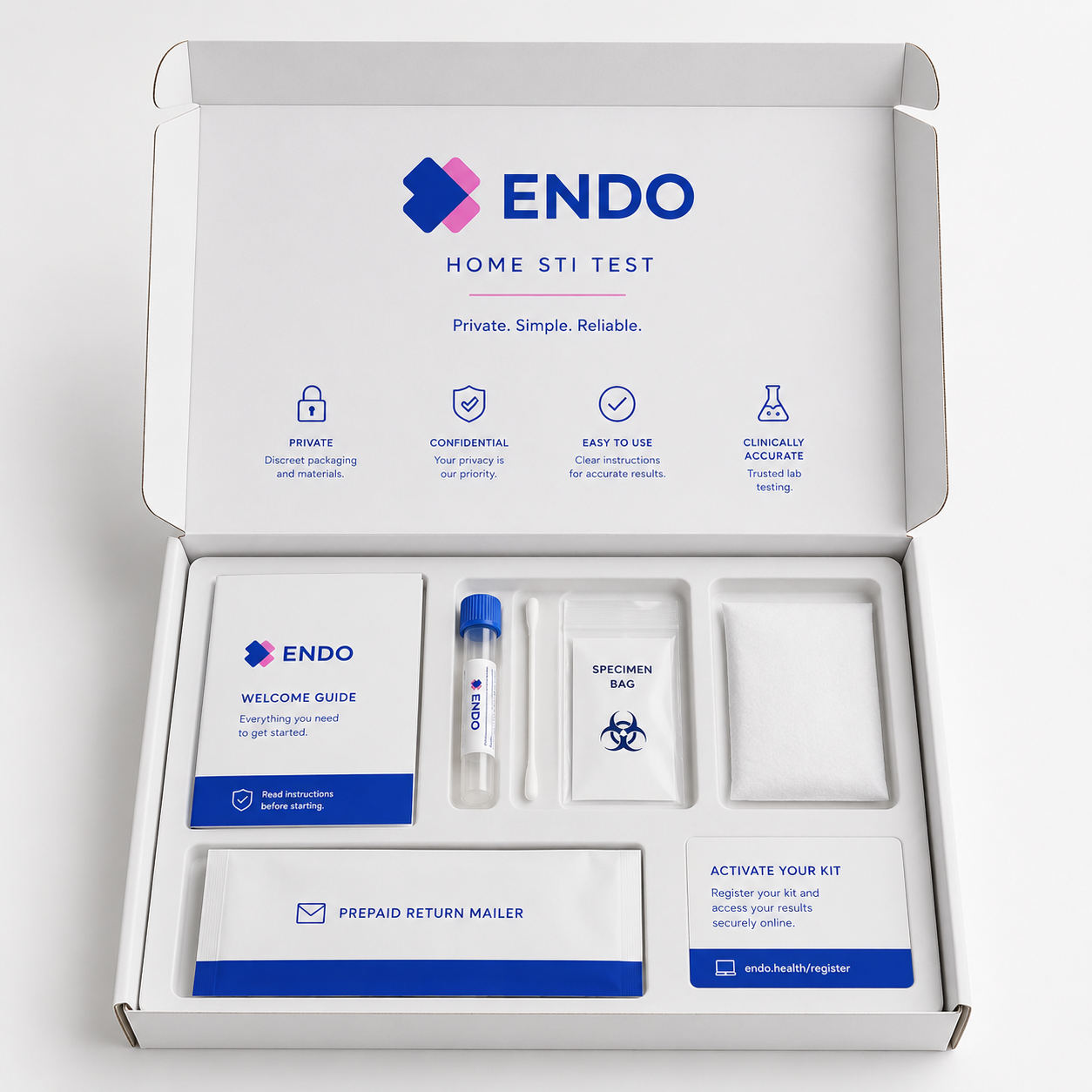
A recurring service can reduce several practical steps: remembering when testing is due, locating a provider, ordering an appropriate test and arranging the next testing episode. Where home self-collection is appropriate, it can also remove the need for a clinic visit solely to provide a specimen.
The subscription model consequently addresses an implementation problem rather than creating a new medical indication for testing.
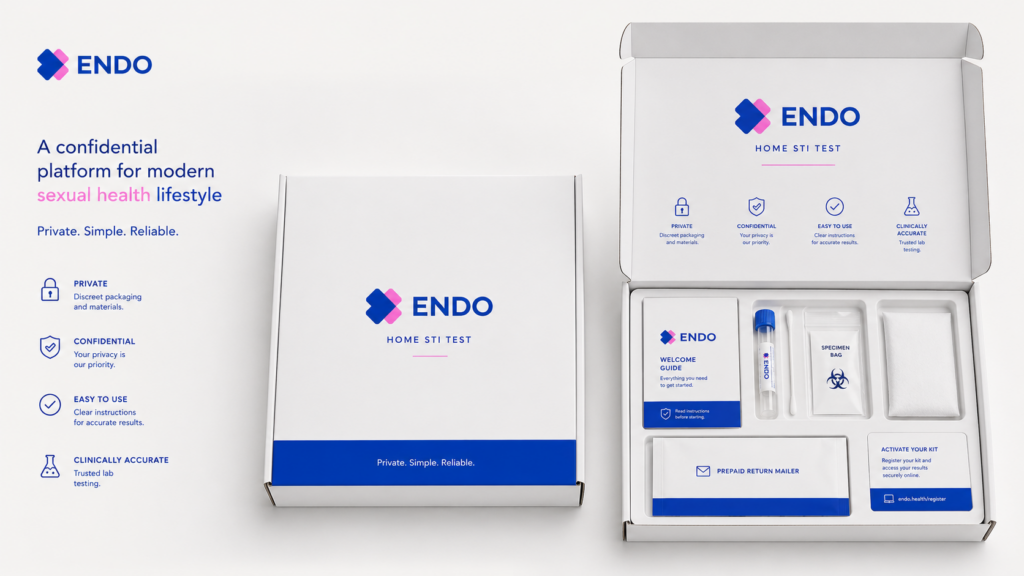
The ENDO Testing Subscription provides a comprehensive testing cycle every four months, combining laboratory testing with selected self-testing options. The four-month cycle is a product design choice for users whose circumstances require more frequent testing.
From testing to healthcare, through ENDO
A positive STI result may require treatment, confirmatory assessment, testing at additional anatomical sites, partner notification or further clinical evaluation. The appropriate response depends on the infection and the test used. Testing is only useful if an abnormal result leads to appropriate action.
This is why ENDO’s testing concept is intended to sit within a wider sexual-health platform rather than operate as an isolated test retailer.
The pathway is:
testing → result → partner notification → appropriate clinical follow-up → treatment where required → prevention and further testing.
This is consistent with the broader public-health approach recommended by WHO and ECDC, in which diagnosis is connected to treatment, prevention and access to care.
What the ENDO Testing Subscription is designed to address
The evidence identifies three separate problems:
1. STIs remain common.
Reported chlamydia, gonorrhoea and syphilis infections remain high in Europe, with substantial increases in gonorrhoea and syphilis over the past decade.
2. Infection cannot reliably be identified from symptoms.
Many STIs are asymptomatic, meaning that symptom-based testing alone will miss infections.
3. Access influences whether people test.
Evidence indicates that offering self-collection at home can substantially increase STI testing uptake without compromising linkage to treatment.
The ENDO Testing Subscription is designed around these three observations. It provides a recurring testing pathway, incorporates home self-collection where appropriate, and connects testing with the wider ENDO sexual-health ecosystem.
It is not intended to replace clinical care or to prescribe the same testing schedule for everyone.
Its purpose is more straightforward: to make regular STI testing easier to access for people who need it.
Count on ENDO!