
For decades, it was believed that sexual health was a technical problem: providing condoms, antibiotics, and colorful flyers in schools would suddenly solve the issue. However, sexual health has never been just a problem confined to a purely biological scale.
Epidemiological data are clear: a consistent increase in syphilis, gonorrhoea and chlamydia in multiple Western countries in recent years. This is not because the microorganisms have become more intelligent, but because the prevention systems have become more fragile. As we see the structure weakening, the risk reorganises itself.
It is a problem of language and the dissemination of information, and above all it resides in a deeply disorganised and ontologically incapable social scale of adapting to the new needs of the new times.
When we observe the growing number of sexually transmitted infections, it is not only the control of these infections from an individual pain perspective that is in crisis, nor is it the consequences for the Public health systems around the world, despite the notable victory that was the fight against AIDS. What is now in crisis within our societies is an ecosystem that allows ignorance to grow, misinformation to spread, and partners not to communicate, and the whole of society not to question.
I. Invisible divestment
International organisations such as the WHO and UNESCO have repeatedly warned of the weakening of structured sex education, especially since the pandemic. In several European countries and the United States, there have been cuts to the curriculum, political resistance to evidence-based education, and the replacement of scientific programmes with moralising, stigmatising or biologically minimalist approaches.
Shamefully, this may not be clear to everyone, as the consequences are not immediate, but cumulative over the years.
Unfortunately, sex education does not work like a vaccine that is administered once. It works like literacy: it is a skill. When it is no longer taught systematically, that intelligence weakens, myths return. And when the myths return, so does the vulnerability of those involved, whether that be you, your child, or someone else’s child that will affect yours.
It is strongly evident that sexual education:
- does not increase risky sexual behaviour;
- increases condom use;
- promotes early testing;
- reduces STIs and unplanned pregnancies.
II. Disinformation as a parallel infrastructure
When formal education shrinks, something else comes along to take its place.
Today, much of sexual literacy is built through social networks, forums, pornography, and influencers. The problem is not the existence of these sources, but their absence of filters based on rigorous information that prevent its often misinformation from spreading. Quality clinical information coexists with malicious conservative trends and absurd conspiracies. At the same time, we know that proven prevention strategies are mixed with dangerous practices presented as innovation.
So, contrary to what is often supposed, the problem is not a lack of access to information. It’s the excess of unorganised noise. This disorganised abundance produces functional ignorance.
III. Digital dating and new relationship patterns
Contemporary transformations in lifestyles are not merely moral or generational; they are a consequence of the most recent Polis’ revolution. Accelerated urbanisation, delayed parenthood, an increase in consensual non-monogamous relationships, international mobility and the normalisation of digital platforms for meeting people have altered the architecture of sexual networks.
Studies in network epidemiology demonstrate that the density, the simultaneous nature of partnerships (a factor that is often overlooked in the present day) and the connectivity between different groups influence the transmission dynamics of STIs directly.
We are not affirming that new lifestyles cause the spread of infections, but rather that they modify the parameters of the system: higher turnover and interconnection require more frequent testing, more efficient communication, and interventions adapted to the digital reality. At the same time, sociological data indicate that younger generations report greater relational diversity and greater use of applications to meet partners, while facing persistent inequalities in access to sexual healthcare.
Thus, the epidemiological equation becomes more sensitive to the social organisation of desire than to the isolated biology of the infectious agent. Meanwhile, the way people meet has changed radically.
Dating apps have transformed the relational space into a dynamic, fast and interconnected market. Studies in public health demonstrate that denser and faster networks of contact alter the transmission dynamics of sexually transmitted infections. This is not about moralising digital dating; it is about understanding that relational speed has epidemiological consequences and developing strategies to address something that is not a problem, but a feature of our times.
IV. A complex problem
This reality is complex, but its logic is simple:
The faster people circulate, whatever the mean, the faster infectious agents circulate too.
We need the circulation of information and prevention to be equally efficient.
This gives rise to the central asymmetry of our times: while technology has facilitated the formation of partners, it has not proportionately facilitated shared responsibility.
Conversations about testing remain uncomfortable. Partner notification is often avoided due to fear, shame or conflict. And traditional public health systems were not designed for anonymous, ephemeral and digital networks.
Therefore, we have a new relational architecture with old risk management instruments.
The technological response to this new relational ecosystem cannot be limited to ‘just another application’, because the problem is not only functional, but also fundamentally structural, relating to exposure in an increasingly conservative, punitive and, at the same time, global society.
It sounds scary to say that you have chlamydia, doesn’t it?
This is where decentralised architectures such as blockchain and, in a more mature form, Self-Sovereign Identity (SSI) and Verifiable Credentials models gain relevance. Rather than storing sensitive data in centralised servers that are vulnerable to breaches, monetisation or misuse, these systems allow proof of an event (e.g. taking a test or changing a clinical status) to be cryptographically validated without revealing personal identity.
Pilot projects in digital health, including decentralised clinical records and verifiable certification of laboratory results, have demonstrated increased user confidence and reduced risk of data leakage, one of the main obstacles to the adoption of sexual health services.
More than a technological trend, it is an epistemological shift: trust no longer depends on a central authority, but on irrefutable mathematical proof – or almost. In an area where the fear of exposure can paralyse communication, encryption can function as an invisible infrastructure of shared responsibility, not to replace medicine, but to enable information to circulate safely at the speed of contemporary relationships.
IV. The contemporary paradox
We live in an era of rapid testing, effective therapies, and robust scientific knowledge. It is impressive how much technology has been developed across Europe and the world, making significant and systematic progress in creating more convenient conditions for users. It has never been easier to diagnose and treat many STIs. And yet, the incidence rate is increasing.
This paradox reveals something fundamental: it is not enough to possess tools, they must be integrated into a functional system for them to really be useful to populations.
Sexual health fails not for lack of science, but for lack of mediation.
Between the casual encounter and the relationship between the partners, there is distance and silence; two strangers who crossed paths in an intimate moment and then returned to their natural place.
Between the positive result and the previous partner, whether used or loved, there is only emptiness.
Between knowledge and action, there is social friction.
It is in this gap that the risk of a pathological network is established.
Testing for sexually transmitted infections has moved beyond the exclusive domain of hospital laboratories and the lengthy bureaucratic processes of the system. The dissemination of NAAT (Nucleic Acid Amplification Tests) molecular tests, which are the gold standard today for chlamydia and gonorrhoea, has allowed for high sensitivity even in self-collected samples, reducing logistical and psychological barriers.
Meanwhile, point-of-care testing devices with response times of under an hour and validated self-tests for HIV and other infections have been shown to increase screening uptake, particularly among populations who avoid conventional services due to stigma or convenience.
More recently, microfluidic platforms and portable biosensors are bringing molecular diagnostics closer to the domestic scale, integrating digital reading and eventual secure connection to health applications.
The necessary innovation is not only in analytical precision, but also in reorganising time: between suspicion and confirmation, weeks are no longer the norm, but rather minutes or hours. While the timeframe shortens, the possibility of faster intervention, earlier notification, and more effective interruption of transmission chains opens up.
V. ENDO as a mediation infrastructure
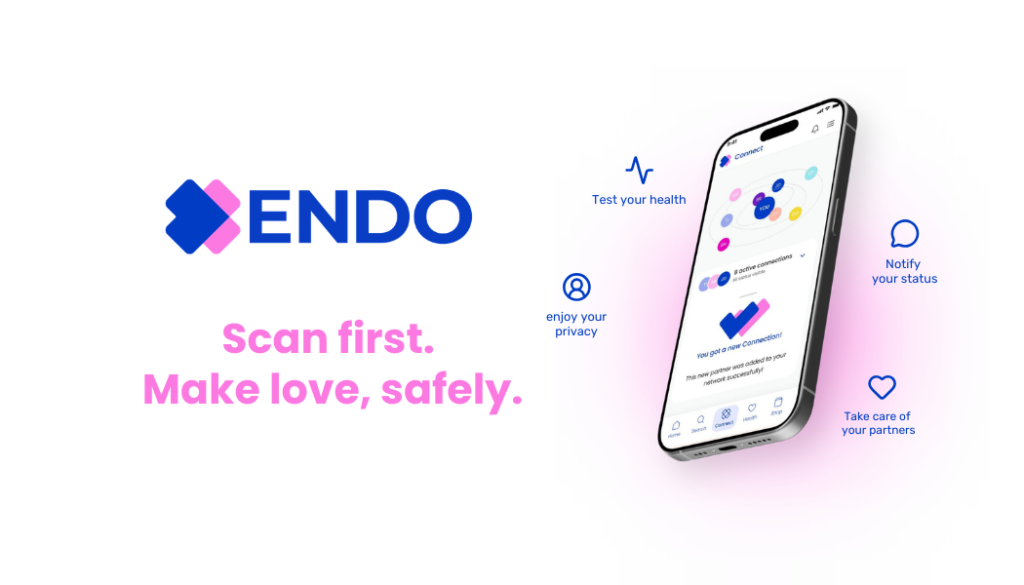
ENDO was born in this intermediate, cold and empty space.
It is a project deeply rooted in our knowledge of how this problem silently affects individuals, families and communities.
Our team, each individually, knows that they are changing the world, transforming it into a place where relationships are easier, where the idea that those who share intimacy, sometimes for fleeting moments of pleasure that we are not in a position to judge, do not have to suffer for it for weeks, months or even years.
We are not just another tracking app or information repository, but a secure mechanism for connecting individual responsibility and collective impact.
- Its principles are simple:
- There are no public profiles.
- Personal data is not shared.
- There is no social exposure.
- There is encryption technology, epidemiology and, above all, digital ethics.
- Health status changes can be communicated anonymously and responsibly.
- There is reliable but free information provided by healthcare professionals.
- There is the opportunity to receive the most convenient technology available.
- There is a whole interesting world of sexuality to discover.
We believe that by removing the fear of identification, one of the main barriers to notification is removed. By centralising evidence-based information, we reduce our dependence on informal sources. By integrating laboratories, testing, prevention and access to treatment within the same ecosystem, we reduce the fragmentation of a previously disconnected system.
ENDO does not replace sex education; we deliver it.
It doesn’t replace the healthcare system, we integrate it.
ENDO acts as an operational bridge between literacy, diagnosis and action.
In times where contacts are so quick and numerous, the only effective response is a fast information network.
VI. It is not an app; it is a reorganization of accumulated knowledge.
Historically, advances in public health have occurred when the way society manages risk has been reorganised: sanitation, vaccination, population screening. Each innovation created a new layer of mediation between the individual and the invisible threat. Today, the threat is not only biological. It is structural.
The challenge of contemporary sexual health is not to convince people that microorganisms exist. It is to create conditions in which responsibility circulates with the same ease as desire.
If the 20th century built antibiotics, the 21st century needs to build infrastructures of trust so that they reach those who need them in time. We already have all the tools we need
ENDO proposes precisely that: a technology that organises collective responsibility without amplifying exposure.
The pandemic of sexually transmitted infections is preventable, but this depends on how we structure our connections with each other.
For all this and what is yet to come,